Debtor list
Debtor List: What It Is, How It Works, and How to Check
Understand what the debtor list is, how it works, and how to check it.

“Selling on credit” is a commercial decision. In Portugal, that decision is often made fast: an order comes in, the team wants to close, the invoice is issued — and only then the question that really matters appears: “What if they don’t pay?”
That’s why the debtor list stopped being a “collections topic” and became a prevention topic — and checking the debtor list before selling on credit is one of the most direct ways to reduce surprises. The company that checks before offering payment terms reduces surprises, protects cash flow, and avoids letting a single default wipe out the margin from multiple sales.
In this guide, you’ll understand what a debtor list is, how it works, and how to check it in a practical way — with full focus on what matters: making better decisions, selling with more confidence, and reducing risk.
1. What a debtor list is
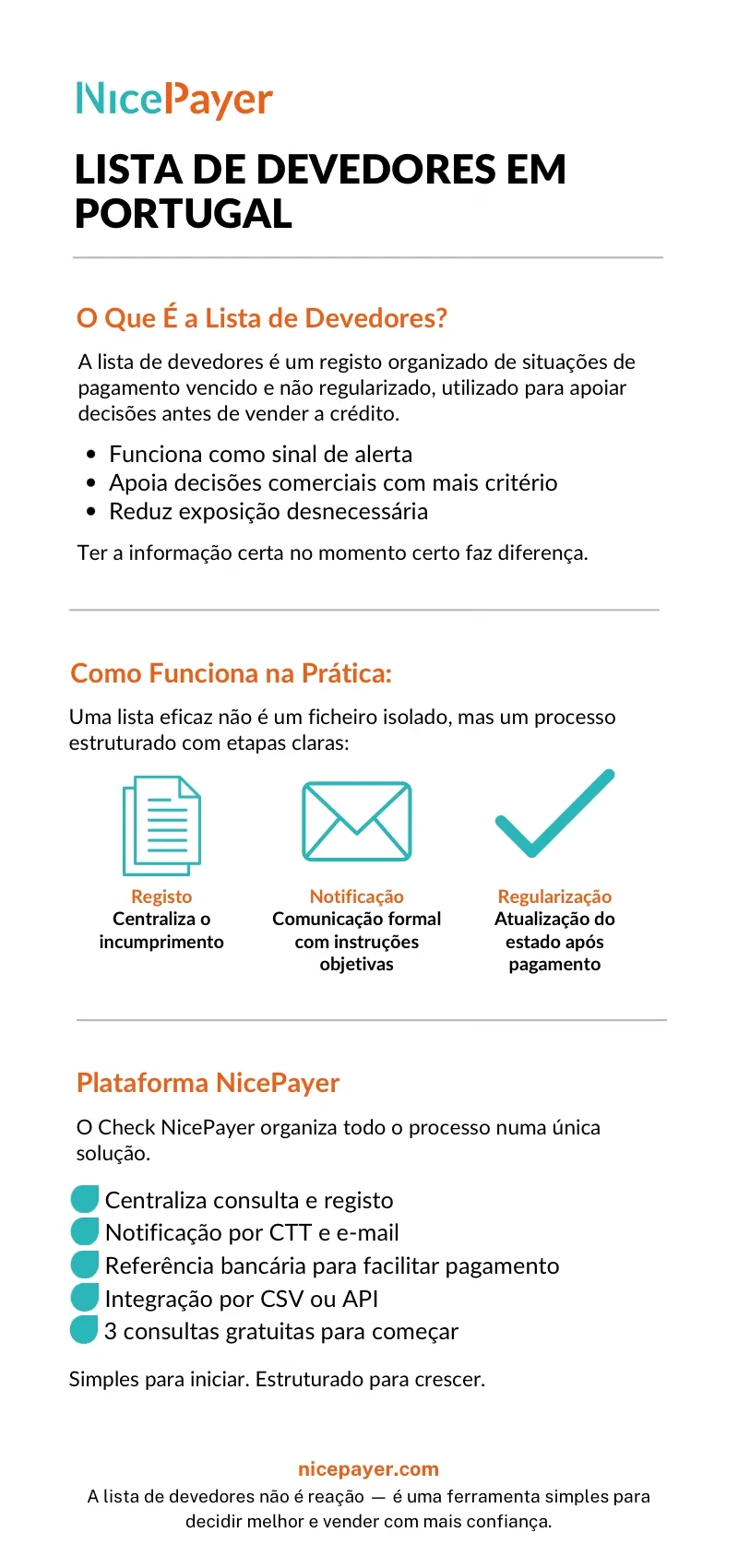
The debtor list is an organized record of overdue, unpaid obligations that have not been settled, used to support decisions before selling on credit. In practice, it works as an “early warning signal” so the company doesn’t move forward blindly.
The main point is not having “more information.” It is having the right information at the right time: before delivering, before issuing an invoice on credit, before taking on exposure.
2. Why a debtor list is useful in a company’s day-to-day
Most receivables problems don’t start in collections. They start at the sale — when the company grants payment terms without confirming risk.
When a customer misses a payment, the effect is broader than a late invoice.
- Cash gets tighter: the money that was “expected” doesn’t come in.
- Operations become more expensive: time and energy are spent on collections and follow-ups.
- Predictability drops: planning becomes harder and decisions slow down.
- Margin suffers: a single default can erase the results of multiple sales.
Checking the debtor list before selling on credit is not bureaucracy. It’s margin protection.
3. How a debtor list works in practice
A useful debtor list is not a notepad. It is a process with clear stages — from registration to resolution.
- Registration: centralizes the default information and the case data in one platform.
- Notification: the debtor is notified with objective payment instructions via postal notice (CTT) and email.
- Settlement: when payment is made, the status is updated to reflect the situation.
This cycle delivers two real advantages: it prevents repeat mistakes (selling again to someone who already defaulted) and speeds up resolution (a clear path to payment).
4. Como consultar a lista de devedores antes de vender a prazo
A consulta à lista de devedores deve ser rápida e direta, porque decisões comerciais não podem esperar dias. Se quiser fazer isso agora, pode verificar antes de vender a prazo e ter um sinal de risco em minutos.
A consulta tem um objetivo prático: confirmar se existe registo relevante que mereça atenção e, a partir disso, ajustar a decisão.
- Se não houver sinal relevante, a venda segue com mais confiança.
- Se houver sinal, a empresa ganha tempo para agir com inteligência: ajustar prazo, pedir adiantamento, rever limite, exigir condições mais seguras.
This isn’t “distrusting” customers. It’s managing risk like a business.
— Wenderson Wanzeller
5. Registration, notification, and settlement: what each stage solves
When someone hears “debtor list,” they tend to think only about collections. But the real value is the method — each stage exists to solve a specific problem.
- Registration solves organization: it prevents lost information, reduces dependence on individuals, and avoids “everyone having their own version.”
- Notification solves clarity: communication arrives in a formal and direct way, with payment instructions.
- Settlement solves consistency: when paid, it is reflected in the status, without noise or doubt.
In business, what often delays payments is disorganization, friction, and lack of process — not only “bad faith.” That’s why a clean workflow improves results.
6. How the debtor can pay: bank reference and clear guidance
Making payment easier increases the likelihood of settlement. When a bank reference is available, the process tends to be faster and less error-prone (especially for finance teams handling many payments per day).
With notifications via CTT and email, and clear instructions, the debtor knows exactly what to do — without back-and-forth, endless calls, or message threads that delay the solution.
7. Debtor list integrated with ERP/CRM: when it makes sense
At first, many companies run these checks manually and occasionally. The problem is that, with volume, manual work fails: someone forgets, someone does it outside the process, someone approves under pressure.
That’s why, as operations grow, the debtor list needs to become part of the workflow.
- CSV import: ideal for simple routines, lists, batches, and teams without dedicated development.
- API: ideal for automating checks and registrations inside the ERP/CRM at the exact moment of approval and invoicing.
The gain is simple: consistency. The rule is followed every time.
8. Check NicePayer: check, register, and settle the Debtor List in Portugal

Check NicePayer was designed for a real-world scenario: companies that sell on credit and need to reduce risk without complicating day-to-day operations.
- It centralizes checks and registrations for the debtor list.
- It enables notifications via CTT and email, with payment instructions.
- It includes a bank reference to make settlement easier.
- It scales through API and CSV import.
- It lets you start simply with three free checks.
The logic is straightforward: check before selling on credit and, when necessary, run a complete process through settlement — without improvisation.
9. Frequently asked questions about the debtor list
- How do I start using the debtor list? Start by checking before selling on credit. If needed, proceed with case registration, notification, and settlement.
- Is the check fast? Yes. The goal is to confirm risk in seconds, at the moment the commercial decision is made.
- What do registration, notification, and settlement mean? Registration centralizes the default; notification guides payment via CTT and email; settlement updates the status after payment.
- Is there a bank reference for payment? Yes. A bank reference makes settlement easier and reduces friction.
- Can it integrate with internal software? Yes. You can scale with CSV or API.
10. Conclusion: a debtor list is prevention, not reaction
A company that waits for problems is always chasing. A company that checks before selling on credit operates with predictability.
The debtor list is a simple tool when used correctly: it improves decisions, protects margin, and reduces surprises. And when there is a default, a complete registration, notification, and settlement process shortens the path to payment.
If your operation sells on credit, the starting point is objective: check before you move forward. The Check NicePayer lets you start with three free checks and scale with CSV or API as volume grows.
Share this article
Authorship

Author
Wenderson Wanzeller
Specialist in credit analysis, risk and software engineering applied to business operations.
Read also